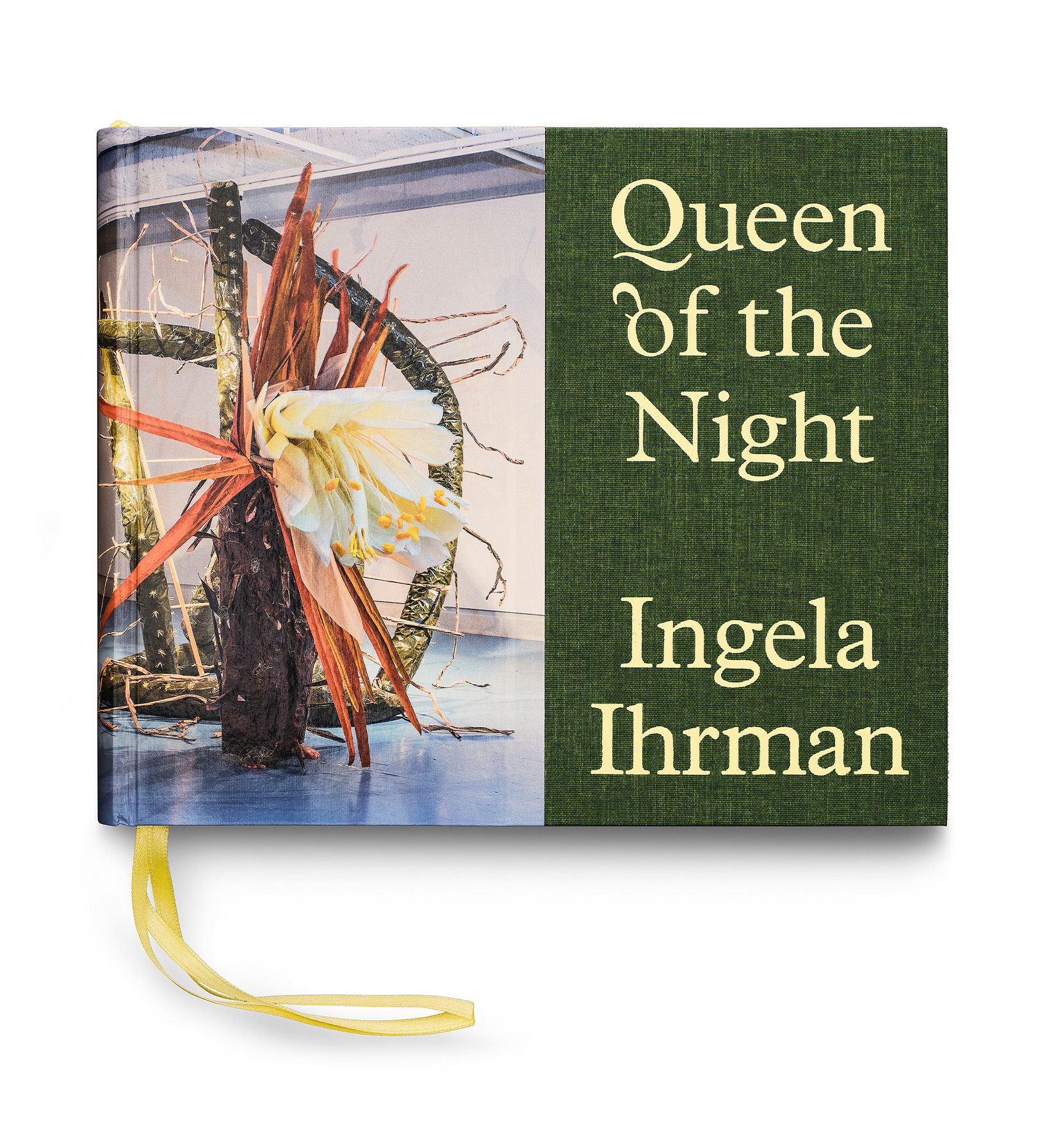
Ingela Ihrman in conversation with Caroline Malmström. The conversation is an excerpt from the artist’s monograph Queen of the Night: Ingela Ihrman.
Caroline Malmström: Our first collaboration took place in 2013, when you stood in a pond as the giant water lily Victoria amazonica. Immediately afterwards, you recreated the foul-smelling Amorphophallus titanum for a performance in a greenhouse in Venice. What is it about these giant flowering ladies that attracts you?
Ingela Ihrman: I recognise myself in how they strive in different ways to attract someone. Exposing your desires makes you vulnerable. What if no one shows up? What if you make a fool of yourself in an elaborate outfit? I enact my flowerings with a mixture of fear and delight, but there is nothing worse than not daring to live life to the fullest. The Amorphophallus titanum makes itself beautiful and attractive by smelling like rotten meat, foot sweat and burnt sugar. Passion flowers fold back layer after layer of petals and fringes and try to get pollinators to come really close by offering sweet drinks from their nectary glands.
In the 19th century, British colonisers transported seeds from the giant water lily Victoria amazonica from the warm waters of the Amazon River delta to coal-fired greenhouses made of steel and glass. They named the species after the queen and were determined to get the world’s largest water lily to bloom in Britain. When it finally did, the plant was described as a spectacular “Wonder of Nature” and long queues formed outside the illuminated Victoria greenhouses of botanical gardens. Throughout art history, there are many analogies between water lilies and the female sex, labia and petals. The objectification of women and nature go hand in hand.
My giant water lily blooms confidently and phallically upright, with thorns if it needs to defend itself. It wants to take up space, but not necessarily to please. The costume allows me to be both visible and invisible at the same time. My own female body hidden under layers of papier-mâché and fabric.
CM: Would you like to share how your work on a new artwork takes shape?
II: It often starts with me being moved, perhaps by something everyday yet incredible. It can be something very big or small and ephemeral that I marvel at and want to try to grasp and tell others about, but that can’t really be put into words.
When I was a student at Konstfack, I constantly felt out of place and compared myself to others. I really had to brace myself when it came to bringing my ideas to life and giving shape to the materials. I remember telling myself, “Yes, but the thing is… young artists today want to dress up as water lilies and perform in front of an audience in a pond.” It helped to think that I was part of a new generation because, after all, I had been accepted into the school. I had to practise holding on to what fluttered inside me – a glow, a giggle or a pain.
Freud talks about this in a text on daydreaming and poetry. He asks himself: What is a poem? How does the poet work? How is the poem created and why are we drawn to it? He writes that everyone plays and dreams, both children and adults, but that part of becoming an adult is to start keeping it secret from others. The work of the poet, and
also the artist, means to continue playing with language and materials as an adult, even though it may evoke shame and doubt. The reason it is so delightful to enjoy art or poetry is that it allows you to indulge in your own forbidden games and dreams for a little while.
Overcoming embarrassment and bringing such a daydream into reality so that I and others can see it, and maybe even touch it with our hands, is the opposite of alienation.
CM: Your work comes across as very personal and honest, which is perhaps why it touches so many people. Many of your works are based on an individual of a certain species or genus – a giant clam exploring different liminal states, a separated fig, or an oil bird mother feeding her baby – from which you carve out characteristics or personalities. Yet these positions are always fluid, and the audience often sees a human hand, or a pair of toes, sticking out from under the costume. How would you describe your interest in the subject, in subjectivity?
II: When I first tried to find words for what I do, it felt true to say that I explore what it is like to exist. What is it like to be someone or something? What is it like to be alive, social, fertile, a rose or human? Later, I came into contact with the ideas of posthumanism, which reflect on humanity’s relationship to matter and the more-than-human. Posthumanism offers a way out of subjectivity, where the boundaries of the self are porous and everything is permeated by waves and by life. My body is a landscape and the landscape is a body. Imagine if that were the case, what a relief!
But I often feel lonely and long to be part of something bigger. My performances are a way of practising opening myself up – letting myself into the world and the world into me. I don’t think it’s easy at all, but maybe we can practise together.
CM: Over time, you have built up a rigorous artistic practice with a long series of exhibitions and works behind you. Do you see any common thread in how your practice has been refined or deepened over time?
II: I like to build on the slightly longer threads, such as in the series of flowers or the idea of an inner ocean. Another long thread is what it’s like to be on the inside: to be swallowed whole by someone else, like Jan Lindblad if he had been eaten by the anaconda he wrestled with in a river, or to be a small child inside your mother’s body, or to be inside a costume. When I’m a fig, splitting myself in two, the cut only reveals the inside of the fig. My own body is still hidden in one half of the suit. It becomes a kind of peek-a-boo game without anyone peeking out, except with their feet.
Perhaps I should have settled on a method and figured out how my process works, but that’s really not the case. Nowadays, however, I feel more empowered than insecure when I learn about other artists’ processes. Everything is both similar to and different from how I work..
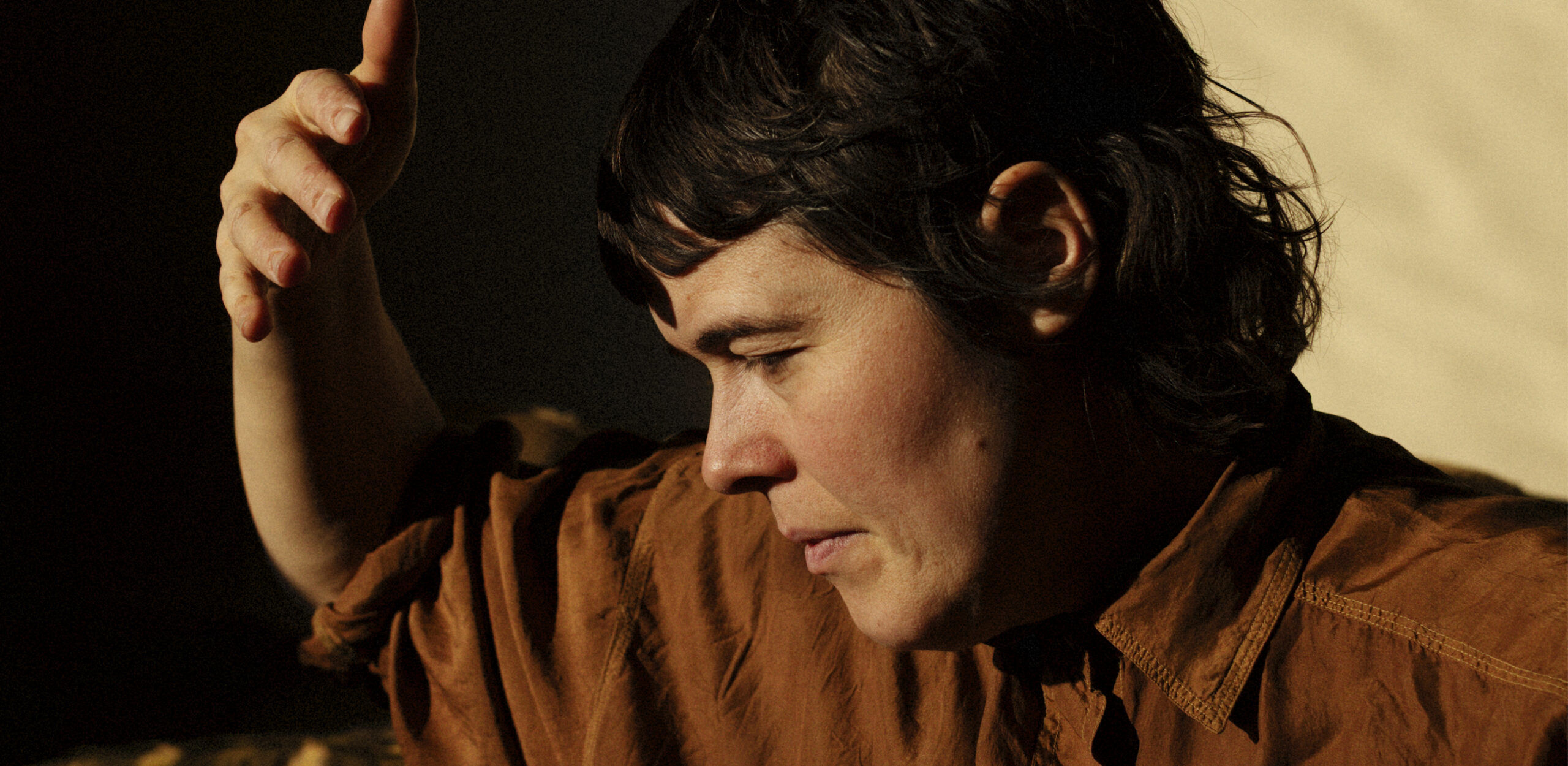
Portrait: Ingela Ihrman. Photo: Märta Thisner