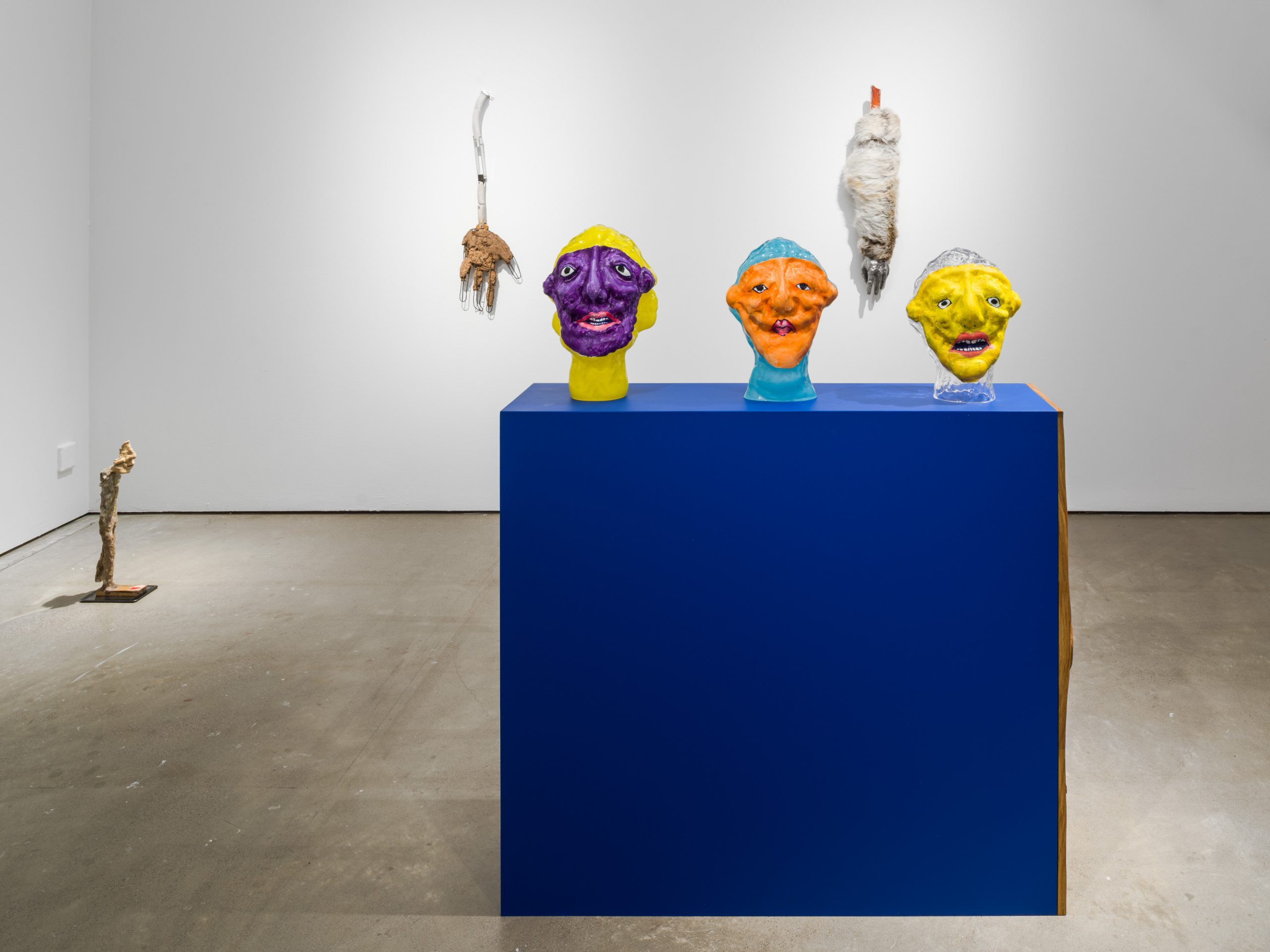
Interview with Olof Marsja
Curator Annie Jensen (AJ) in conversation with Olof Marsja (OM)
AJ: You describe some of your works as characters and figures inhabiting a mysterious landscape. Could you tell us a bit more about this landscape and its inhabitants? Who are these characters and what do they want?
OM: The landscape my characters inhabit lies in the shadow of exhausted identity politics. I’ve ventured into the shadow because it feels like that’s where I belong. Among those who accompany me are Den Frusne, Pea’n’Tjerry, and Fresh Mint. They serve as guides and guardians of their territories.
AJ: The choice of materials is central to your work—both in terms of how you find different types of materials and how you work with them. You talk about the inhabited history of these materials and how you try in various ways to highlight and reformulate it. Could you explain why this is important to you?
OM: I’m primarily drawn to organic materials because of their tactile quality, which I appreciate. They’ve been handled by humans since time immemorial, whereas chemically processed or manufactured materials are, in a way, memoryless. Of course, this is a qualified truth. Regardless, it’s important for me to mix organic and non-organic materials freely. Partly because of the different temporalities inherent in both the materials themselves and the techniques used to work them. This gives the sculptures different timelines, creating a certain ambivalence regarding their place in time and space.
Reindeer fur, which I’ve been working with over the past year, belongs to the first category. I like this material because you cannot avoid the fact that it represents an encounter with another animal and everything that entails. The fur carries a narrative, which the writer Linnea Axelsson captures in her epic Aednan in the line: “To carry this animal body with you.” The reindeer is something the Sámi must constantly relate to, for better or worse, both literally and metaphorically. But by combining the reindeer fur with industrially produced objects—a sports sock or a piece of a plastic bag from Lidl—it becomes part of a larger whole. What I’m trying to get at is that these things do not exist in isolation but coexist.
AJ: I experience your works as playful and humorous, yet at the same time filled with seriousness and something almost unsettling. It’s hard to tell whether the faces of the sculptures are friendly or menacing. This makes me think of something you’ve mentioned before—that through your work you want to highlight and examine Sweden’s colonial historiography, specifically how the Sámi people have been represented, as well as the indoctrinated racism that resulted from it. Could you elaborate on this element of darkness/playfulness in your work?
OM: I notice my choice of words may be slightly off. I don’t mean exactly to illuminate the colonial historiography as such, but rather to process and work through what came in its wake—shame, inferiority complexes, historical amnesia, and so on. To avoid getting stuck in this, which largely relates to personal grief and reflection, I use the playful. It has given me room to renegotiate and wrest power from the hands of the historians. At the same time, it is a history that has left concrete traces in people and in the land, hence the ever-present darkness. From another perspective, the dark and the playful are different ways for me to give my sculptures weight and agency. We enter the territories of my figures, and there their rules apply—rules they will not relinquish lightly.