More about The image of war
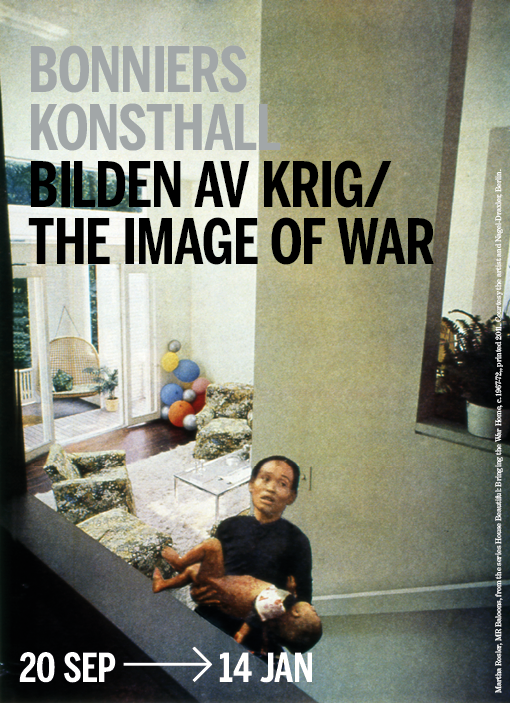
The Image of War at Bonniers Konsthall is a large group exhibition about seeing violence in images. The exhibition addresses questions concerning their effect, production, and circulation. In considering the relationship between those who depict, those who are depicted, and those who subsequently see what has been depicted, we are interested in the ways people engage with these scenes. The point is that images in which violence appears operate on a complex ethical, moral, and political wavelength that demands reflection.
Reflecting on this type of imagery does not dispute the necessity of creating such images. Rather, it suggests that a crucial political project is to find ways of seeing violence.
Images of this kind are often approached in one of two distinct ways. Either they are thought to represent a form of devastation-voyeurism, in which what is more obscene than the violence itself is the need to materialize and authenticate it through visualization—resulting in an increasing apathy toward suffering. Or they are seen as enabling an awareness that can lead to action. That is to say, although the visualization of violence risks generating a tolerance for its production and observation, without such images we would face a greater tragedy: violence without images, which, unseen, remains unchallenged. The problem is that both of these perspectives can be true.
Images like these seem capable of doing good and harm at the same time. How can we better understand this contradiction? And how might one give form to these events without ending up in a paralyzing in-between? These questions draw our attention to the fields within which images of violence circulate, and the consequences of their visualization.
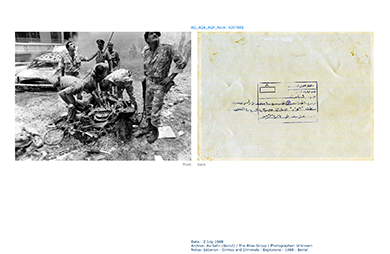
An image of devastation and human suffering can make a moral or political claim if it is situated within a context and if those who see the image understand themselves as connected to what they see. The viewer must perceive themselves as somehow part of what is unfolding—recognizing human needs and pains, and therefore obligated to act upon what is depicted. But the viewer must in doing so look beyond a frame that reduces economic and political conditions to merely human situations, in which the suffering of others is perceived as somehow inevitable and the overarching tragedy is that this is simply how the world works.
It is within this frame that the needs of certain people are relegated to an uncertain dependence on the charity of others, in an endless cycle of temporary relief rather than permanent change. As the critic and theorist John Berger put it, a depicted moment of suffering can mask a far more significant confrontation: the absence of political freedom. Within political systems as they currently operate, there are no legal means to effectively influence how wars are waged, even though they are often carried out directly or indirectly in “our” name. The actions that do take place occur between people, through channels separate from governments and states.
As many have argued, images of war remind us of the brutal lived reality behind the abstractions of political theory. But what is it they enable us to see? More disturbing than perceiving these images merely as part of a relentless exploitation of misery’s spectacle would be to realize that we do not see the politics within them—that we do not see, in the image, the political system that makes the violence possible. The intention behind an image of the kind addressed in this exhibition serves little purpose in a society that sees the violence but fails to see what that violence, in turn, reveals. The question is: what is it that the violence in the image shows us? The challenge is to learn to see it.
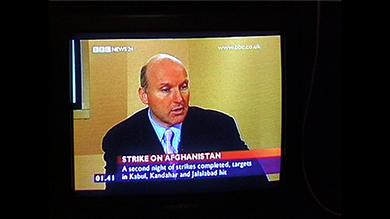
Certainly, violence is often denied an image, and of course there are abuses—such as structural injustices—that cannot be depicted in this way. But the focus of this exhibition is the notion of the image in which we see, with dreadful clarity, violence. War is politics by other means, and thus a sufficiently delineated field within which to begin reflecting on questions concerning violence and image-making—as Virginia Woolf, Susan Sontag, and Judith Butler, among others, have done. Here, “war” can be said to encompass conflicts between states, both disguised and performed as spectacle, as well as uprisings and counter-insurgency. An image may emerge from conventional cameras as well as newer image-making technologies.
Rather than invoking straightforward accounts of violent acts, the exhibition omits the documentary and instead focuses on artworks that grapple with questions concerning the image while also relating to the violence of war—that is, artworks that are at once about violence and about its image. The aim is to render the image and its making perceptible. While journalists, activists, citizens, and surveillance technologies may produce images in which the violence of war is visible, the artist can work through the image. Especially today, when the classical war painter who portrayed battles has been replaced by the contemporary artist, who not only depicts but also examines the function of the image and the politics that arise as a consequence.
Take, for example, Martha Rosler’s well-known series House Beautiful: Bringing the War Home, featured in the exhibition. By merging images of mutilated Vietnamese civilians from the Vietnam War with images from the homes of wealthy Americans, Rosler compels the viewer to reconsider the relationship between “here” and “there” within the world of images. In doing so, the collages show how the collective experience of war is shaped by the media image. But what is crucial is that what we may call mediality becomes perceptible: rather than simply encountering another image, we become aware of what is being shown and how it is being shown as an image.
Encountering mediality enables an awareness of the very means of visualization. Recall, for example, what Guy Debord achieved within film, or even more pointedly, what Bertolt Brecht developed in theatre through the Verfremdungseffekt—a technique associated with gestures of montage, fragmentation, contrast, contradiction, and interruption. This technique shifted the audience’s awareness of what they were seeing. Instead of being fully absorbed by the fiction of the play, they were placed in a situation that made them conscious of the theatre’s mediality.
Today we see more and more images in ever-increasing resolution, yet we remain the same witnesses as at the dawn of photography. If mediality is the process of making visible as such, then in the exhibition it is rendered perceptible through a kind of enactment of the image. What it means to encounter an image of violence is not merely to enter a mode of objectification or representation but to be engaged in understanding a double display: on the one hand the demonstrable, that which can be made visible; and on the other, the indescribable, the inaccessible.
PARTICIPATING ARTISTS
Lawrence Abu Hamdan, Mari Bastashevski, Broomberg & Chanarin, David Claerbout, Phil Collins, Bracha L. Ettinger, Iman Issa, Alfredo Jaar, Gavin Jantjes, Gülsün Karamustafa, Gerhard Nordström, Kiluanji Kia Henda, Eva Löfdahl, Rabih Mroué, Trevor Paglen, Mykola Ridnyi, Michael Rakowitz, Martha Rosler, Natascha Sadr Haghighian*, Gilles Saussier, Susan Schuppli, Allan Sekula, Indrė Šerpytytė, John Smith, Sean Snyder, The Atlas Group, and Maximilien Van Aertryck & Axel Danielson.
*Performance on 24 November.
A special film programme presents works by: Marwa Arsanios, Harun Farocki, Jumana Manna & Sille Storihle, Trinh T. Minh-ha, and Oraib Toukan.
Curator: Theodor Ringborg
PROGRAMME AND TALKS
The exhibition is accompanied by an extensive programme of discussions. A conference will be held on 24–25 November. In addition, a poetry anthology edited by Raqs Media Collective and Theodor Ringborg will be published by Art&Theory.
Utställning