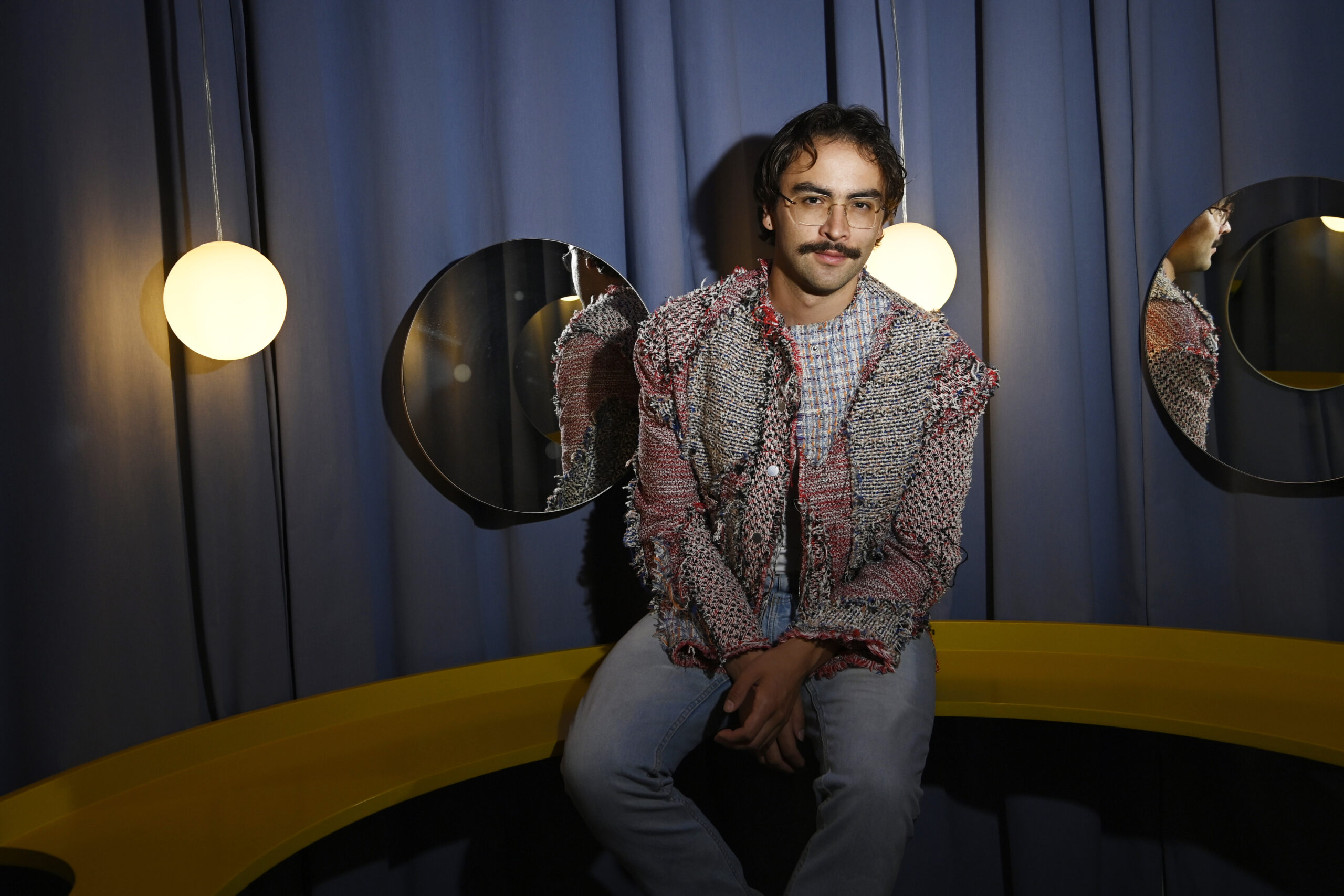
Interview: Afrang Nordlöf Malekian
Curator Nina Øverli (NØ) in conversation with Afrang Nordlöf Malekian (ANM).
NØ: I would say that you have a social practice both in that you create participatory performances and in that you often involve others in your network to shape your works. What does social practice mean to you, and what do you think it brings to your artistic practice?
ANM: My starting point is that collaborative creation is fundamental to all human beings, because no one can express themselves in a vacuum – it is in the friction with our surroundings that we understand who we are. Audience participation thus becomes a direct way of shaping something together and a method of breaking down the barrier between viewer and art object, challenging the idea that art should be experienced in silence and at a distance. It is a social practice that can be traced in part to my background in editorial work, where editing functions as a collective effort and an intrinsic part of the writing process. At the same time, I am driven by desire and spontaneity, where social interaction is essential. I might be talking to my boyfriend or my friends about something I am researching, and then we come up with a fun idea – and then we go for it! Keeping up with the Iranians is a prime example: a close, sometimes chaotic collaboration with choreographer Sepideh Khodarahmi, performer Edwin Safari (Jafar The Superstar) and Mia Herman. From the meeting of our different skills in visual art, choreography and theatre, an all-encompassing work emerges.
NØ: After spending time with your works, I see how they relate to each other, how they are connected in different ways and reflect each other, and how different elements often recur and develop further in new versions. Can you tell me more about your process and why you return to certain themes?
ANM: The Eclipse of the (Fe)Male Sun, made in collaboration with art historian Nour Helou, is the work where my artistic process took shape – a mix of archival research and artistic exploration of how aesthetics hybridise and create new cultural expressions. Initially, I mostly wrote anecdotes about how this happens in everyday life – at a house party, in a sealed opera house or in a passport photo studio – but in recent years, these stories have been transformed into performances, sculptures and murals. This has led me to return to earlier works – to develop an idea in a different medium or because they have subsequently shown me something I did not see at the time. The Taste of Pomegranate was originally an assignment when Iliada Charalambous and I were studying together in the Netherlands. We were tasked with holding a workshop, and I convinced Iliada to draw pomegranates, then we wrote some personal stories about the fruit and I designed the tablecloth. The format has since been further developed for each exhibition, the stories have deepened – the pomegranate has been given its own voice – the tablecloth has become longer and the pomegranate seeds have been used for everything from salad toppings to syrup. Ahead of the exhibition at Bonniers Konsthall, we decided to hand-embroider every stain on the tablecloth left over from previous performances, a task that Iliada carried out by hand over several months as a way of honouring the dining table as a place for writing history. Now this tablecloth has reached its final destination.
NØ: You have previously said that you want to create performances that you wish had existed in a specific historical context and through which you hope to generate alternative futures. Can you tell us more about this?
ANM: I have long felt that I lacked a language to tell history on my own terms, and it is this language that I try to create in my art. Artistically, it began during a collaboration with the artist Cristian Quinteros Soto, where we researched Iranian and Chilean leftist movements that came to Sweden between the 1970s and 1990s. We met many people who told us about a heroic struggle and exactly how history should be retold. There was no language for me, I was to learn theirs. A frustration grew and a desire to find a way to formulate history based on my own language, where no utopia or culture is exalted, but a language that embraces the complexity of life with all its frictions, flaws and strengths. Comedy became my path there. Paradoxically enough, I was inspired by the writers Svetlana Alexievich and Mahmoud Darwish, where memory – like oblivion – is a living, contradictory material. From this, the work The Art of Cooking with Communist Dreams – From Garlic to Onion quickly emerged, where I hope you will get to taste some new linguistic dishes.
BIOGRAPHY
Afrang Nordlöf Malekian (b. 1995) is an Iranian-Swedish artist based in Berlin and Stockholm, who creates performances and installations informed by processes of hybridization in migratory cultures. Through storytelling he explores how entanglements between precolonial, colonial, and migratory cultural forms in hand-colored photography, social dance, Iranian pop music and fiction, can transform into evasive, flexible forces that advance collective endeavors. Afrang Nordlöf Malekian is represented by Moderna Museet, the Public Art Agency Sweden, and the Arab Image Foundation Library. He has previously conducted artistic research at the Arab Image Foundation and was artist-in-residence at the Cité Internationale des Arts in Paris. His work has been exhibited at venues including the 10th Berlin Biennale, Sophiensaele, Moderna Museet, and Contemporary Art Center, Vilnius.
Image: 1Afrang Nordlöf Malekian. Photo: Christofer Dracke