Participating artists: Zbyněk Baladrán, Chiara Bugatti, Ali Cherri, Öyvind Fahlström, Harun Farocki, Jean-Luc Godard, Ane Hjort Guttu, Hamedine Kane, Kateryna Lysovenko, Asier Mendizabal, Peter Nestler, Daniela Ortiz, Valérie Osouf, Gunilla Palmstierna-Weiss, Christoffer Paues, Samuel Richter, Lenke Rothman, Lina Selander, Peter Weiss.
Zbyněk Baladrán (b. 1973),
based in Prague, Czech Republic
Nearly fifty canvases are aligned on the floor, leaning against a wall. They do not aim at aesthetic contemplation, states a disclaimer written by the artist, but have been produced to be used as instruments for geomancy, an ancient method of divination that interprets markings on the ground. Their abstract and earthy reliefs are scrutinized by the artist, who appears to believe in their magical power, to answer one single, repeated, question: What will be the time, place and intensity of the next bombing of the Gaza Strip? Hung above these paintings, almost illegible scribbles reproduce photographs of Palestinian landscapes of ruins, and underline not only the lack of available images, but also the absence of possible representations of the disaster. Diagrams complete the artwork and show the logos and slogans of international industrial companies involved in supplying weapons to the Israeli army. The question asked with this oracular protocol is: What does it mean to turn to the irrational in order to make sense of a situation of unspeakable violence? If a rationalizing explanation excludes the ethical, could it be worth turning to the irrational?
In his essay The Remorse of the Heart (1986), W.G. Sebald cites Peter Weiss’s notebooks: ”Despite our fits of ’absence’ and ’weakness,’ writing is an attempt ’to preserve our equilibrium among the living with all our dead within us, as we lament the dead and with our own death before our eyes’.” This balance between weakness and courage is typical of the persistent insatisfaction that Sebald sees in Weiss, between his deploration of an apocalyptic world, his refuge into the dream when confronted to the harsh reality of Berlin after the Second World War, and the lucidity he needed to state, in The Investigation, that ”we all knew the society” out of which the forces of genocide could emerge.
Chiara Bugatti (b. 1991),
based in Stockholm, Sweden
Chiara Bugatti’s artistic practice is based on an in-depth investigation of materiality, where questions of monument, power, permanence and transience are intertwined with bodily experiences and historical narratives. Through sculpture, installation, video and performative elements, she often works with materials such as stone, earth and mineral residues, which are treated as carriers of memory rather than as passive substances. In her work, history does not appear as a fixed narrative but as something sedimented in matter, gestures and spatial relationships.
In the installation Poses and Postures (2026), Bugatti takes her starting point from her own family history and the long, silent moments of drawing that she shared with her grandfather in childhood. Despite his experiences as a partisan in the Italian Alps and later as a prisoner in Nazi Germany, many stories remained untold. The work emerges from the couple’s wordless communication and explores the possibility of understanding resistance not only as an act or declaration, but as persistence, repetition and everyday presence. In the installation, Bugatti reuses fragments of her grandfather’s rediscovered drawings – a reluctant donkey, an edelweiss or a man without facial features – and combines them with sculptural elements and photographic details to form a new reading of memory and perception.
The cast stone sculptures, reminiscent of industrial rubber mats with tactile elevations, direct attention to the body’s encounter with public spaces and the invisible orders that organise them. Waiting rooms, transit areas and other environments characterised by movement and regulation become starting points for the works. At the same time, the choice of materials carries a historical charge. The sculptures are made from leftover materials from marble and granite – materials associated with monumental traditions, fascist architecture and political claims to power. In Bugatti’s hands, these symbols of permanence are transformed into pasts that instead emphasise vulnerability and dependence.
Ali Cherri (b. 1976),
based in Paris, France
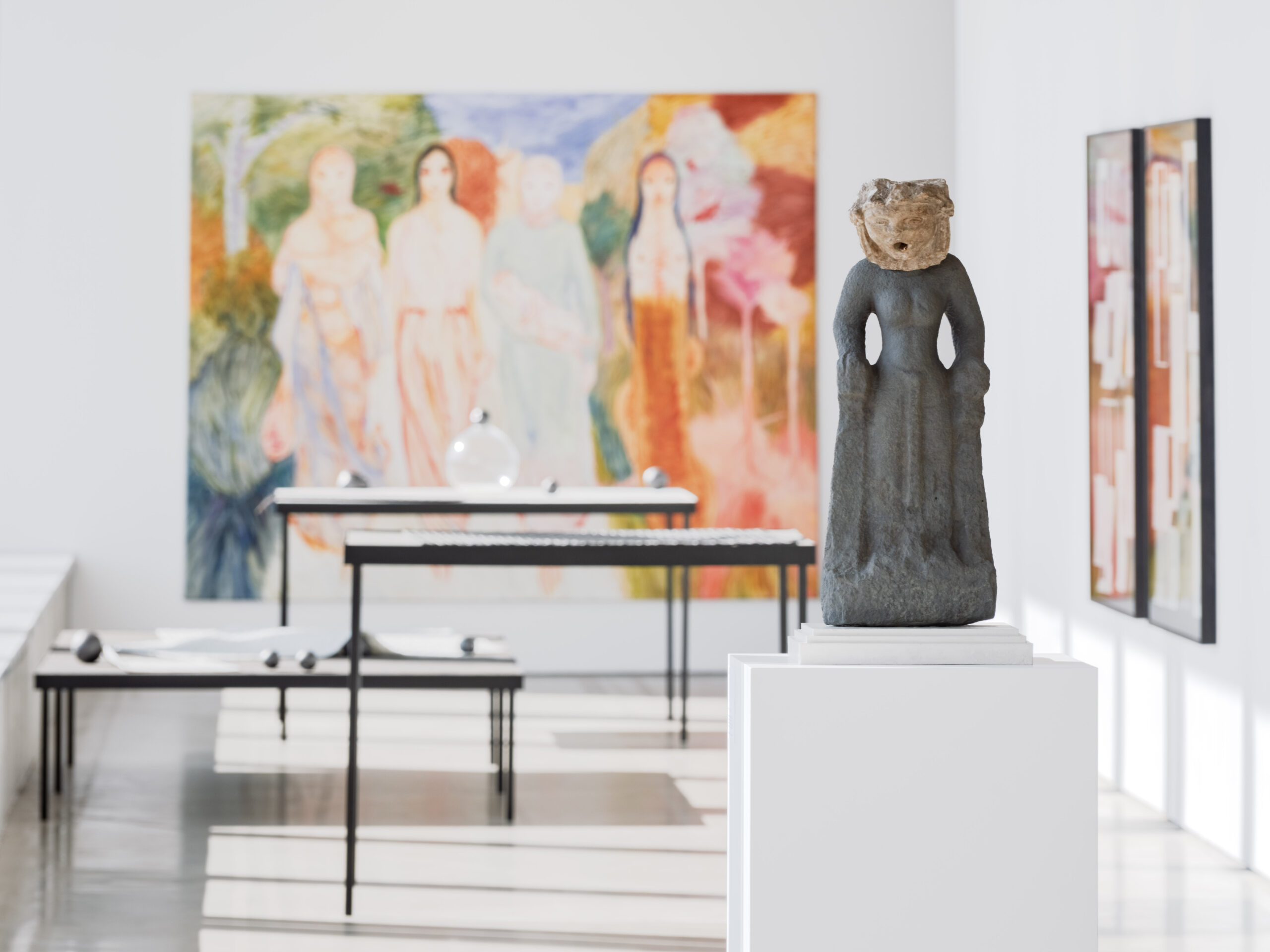
Peter Weiss introduces The Aesthetics of Resistance with a meditation on the intrinsic historical relationship between art and violence, as well as between knowledge and domination, in a famous reading of the Pergamon altar. ”If we want to take on art, literature, we have to treat them against the grain, that is, we have to eliminate all the concomitant privileges and project our own demands into them,” he writes. Ali Cherri’s The Summoner (Grafting) (2026) is the assemblage of an Italian stone fountain head on top of the headless torso of a Thai statuette. The artist challenges the notion of monumentality with this hybrid creature, whose expressive face – wide eyes, open mouth – seems to witness a terrifying scene, and embodies a tension between vulnerability and resistance. Suspended between a monument and a ruin, on the brink of collapse, this sculpture dismantles the canonical representation of power.
In the slideshow A Monument to Subtle Rot (2024), images of statues being torn down from their plinths are interspersed with short fragments of a poetic essay by Palestinian writer Karim Kattan. The text returns to the feeling of belonging to a place that remains undetermined: that it is almost vanished does not matter. Its narrator navigates between the I, the you and the we as if his voice could be channelled and embodied collectively. A similar convergence of voices is to be found in My Place, the text that Weiss wrote after first visiting the extermination camps of Auschwitz and Buchenwald in 1964, a place he felt that he was ”destined for, but managed to avoid”. Walking among the ruins, Weiss is overwhelmed by the at once devastating and hopeful realization that history ”has not ended yet”.
Öyvind Fahlström (1928-1976)
Peter Weiss filmed Öyvind Fahlström in 1961, the year the artist would leave Stockholm to relocate to the USA. The short footage especially focuses on the artist’s abstract drawings of explosions and eruptions, and on his voluminous notebooks and cut-out cartoons where he finds the patterns for his work. At the time, like Weiss, Fahlström invoked a Surrealist legacy and his works depicted an apocalyptic chaos of images and signs abstracted from their context.
In New York, Fahlström incorporated the revolt of the 1960s countercultures in his increasingly prolific practice of painting, installation, performance, film and writing, and his art became simultaneously more critical and more figurative. During the same period that Peter Weiss worked on a series of documentary plays on the period’s anticolonial and anti-imperialist liberation movements, Fahlström worked on a series of new history paintings, with Picasso’s Guernica as model. ”Like many people, I began to understand during the late 1960s that words like ’imperialism’, ’capitalism’, ’exploitation’, ’alienation’ were not mere ideas but stood for terrifying, absurd and inhumane conditions in the world,” he wrote in 1973. ”It became impossible not to deal in my work with what was going on around me: Guernica, multiplied a million times.” Fahlström’s world models and maps of the 1970s aim at the same accuracy and straightforwardness as Weiss’s plays. They keep on depicting a chaotic, apocalyptic world, but this time with the clarity of a diagrammatic representation of data and ideas.
Harun Farocki (1944-2014)
The German filmmaker and artist Harun Farocki first contacted Peter Weiss in 1966, when the latter had become an important figure in Germany’s critical public sphere with his play The Investigation. The student Farocki had heard about Weiss’s contribution to the Russell Tribunal, the investigation committee concerning the US war crimes in Vietnam, that was about to take place in Stockholm. Farocki complained that he could not find any notice of this tribunal in the German press. Twelve years later, in 1978, he contacted Weiss again, this time to offer to record an interview with him in Stockholm for German television. The interview took place in June 1979 and focused on The Aesthetics of Resistance, the two first volumes of which had already been published; Weiss was now working on the third. When Farocki asks Weiss about his research for the novel, the writer answers: ”Something that is crucial to me in every scene – that what is depicted is completely realistic, so that I have a basis for fantasy. Basically nothing is invented.”
Farocki’s documentary films and installations are always grounded in precise research and archival material, and combine a critique of the media with a commitment to historical and contemporary political struggles, including the war in Vietnam and German memorial politics
Jean-Luc Godard (1930-2022)
Asked to provide a short clip as a trailer for a film festival, Jean-Luc Godard took this as an occasion to create a dazzling poem, which is also a tribute to the final lines of Peter Weiss’s The Aesthetics of Resistance. ”And if nothing would be as we had hoped, it would change nothing of our hopes,” the only audible sentence in the short clip, appears to summarize what Godard shares with the novel’s narrator: the persistence of hope and of the future, despite the delusions of failed struggles.
Until his last feature film The Image Book (2018), Godard shared something fundamental with Weiss: a commitment to the genre of documentary montage, which helped them both to navigate between the past and the present. The political aim of such a journey in history might be explained by the philosopher and historian Jacques Rancière, recalling the ambition of his journal Révoltes logiques: ”Official wisdom always invites us to take lessons from the past and to find in history situations that look similar to those we are currently experiencing. What we looked after in history were moments of rupture, blocks of present that precisely thwarted and contradicted an ’evolutionist’ perspective that is seeking lessons from the past. Instead of shedding the light of the past onto the present, we wanted to throw blocks of past into the present, like cobblestones, to fracture the present, to make audible strange and dissonant voices, able to disturb dominant and consensual analyses.”
Ane Hjort Guttu (b. 1971),
based in Oslo, Norway
Nothing should be above us, argue the protagonists of Peter Weiss’s The Aesthetics of Resistance. The histories of art and culture are within our reach, we can take them on, relate them to our concerns. Even in those forms that were designed to glorify superiority and dominance we can find elements that speak to us, that allow us to perceive the shared world out of which they emanated, the flat network of relations within which they were shaped. And we can be anyone: no hierarchy should decide who gets to see or hear, enjoy or produce, interpret or relate.
Horizontality is the operative concept in Ane Hjort Guttu’s multi-screen installation On the Ground (2026), where it figures as both metaphor and motif. One of the videos features shots taken at Schiphol airport outside of Amsterdam. The handheld camera registers the empty, wide landscape of runways and fields, stretching toward the horizon. Airplanes taxi toward gates or runways, but we never see them take off. Over these images, a man talks about his shifting, unreliable states of consciousness: the sometimes painful hallucinations that overcome him, the flickering lights that appear before him as he closes his eyes. The dream, he says, is horizontal. It is a state of visions and new connections, but also of vulnerability. Lying down on the ground you are defenceless. Fascism, he continues, is vertical.
Another screen in the installation shows details from a Dutch landscape painting by Jan van Goyen, which depicts the area where the Schiphol airport is located today. The images show figures in a flat world: workers in fields and swamps, cityscapes nearly merging with the horizon, battling to stay above sea level. On yet another screen, the figures of a Malevich-like, Suprematist composition bounce around on a white background, as if available to play with in some egalitarian video game.
Hamedine Kane (b. 1983), based i Dakar, Senegal and Brussels, Belgium & Valérie Osouf (b. 1972), based in Paris, France
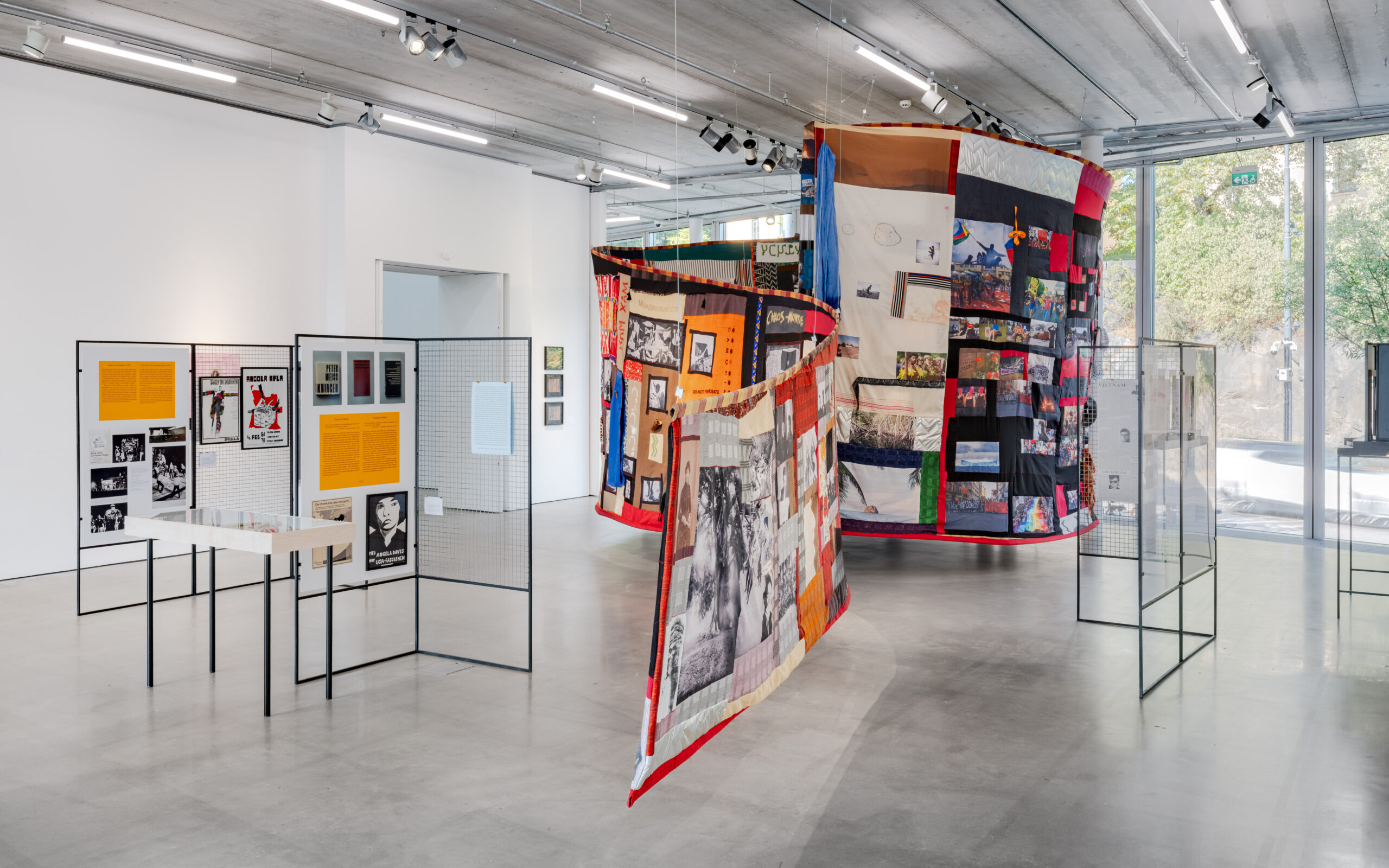
The filmmaker Valérie Osouf and the visual artist Hamedine Kane are both members of the School of Mutants, an international artists’ collective named after a utopian university founded in the late 1970s by Senegalese president Léopold Sedar Senghor on the former slave trading post of the island of Gorée. Osouf and Kane’s contribution to the exhibition, Where the Seams Hold Against the Fixed Narrative (2026), takes the shape of a large assemblage of textile installed as a boat sail, evoking Géricault’s painting Raft of the Medusa (1819), to which an extended interpretation is devoted at the beginning of the second volume of Peter Weiss’s The Aesthetics of Resistance. The painting represents the surviving crew of the shipwrecked French boat Medusa, drifting on a raft near the Mauritanian coast. Weiss describes the black man at the top of the raft as ”the only one to have a free space in front of him,” and understands Géricault’s painting not only as an antiracist statement, but also as a dream of the end of oppression amidst the most appalling tragedy. Kane and Osouf wish that their multi-faceted sail not only reflect the perspective from the raft but also of the people on the African coast.
The artists respond to Weiss’s documentary editing practice in The Aesthetics of Resistance and sew together myriad of images that relate to liberation and emancipation movements, past and recent struggles, and portraits of well-known or anonymous heroes and heroines. They connect different times and geographies to revive the networks that composed the forces of internationalism, panafricanism, tricontinentalism and other alliances that tied together the peoples and the movements that some once considered the defeated.
Kateryna Lysovenko (b. 1989),
based in Vienna, Austria
In the painting Madness of Fascism (2026), the Ukrainian artist Kateryna Lysovenko examines the relationship between victim and perpetrator, between vulnerability and power. The starting point is the experience of war and the insight into the seemingly absolute asymmetry between those subjected to violence and those who perpetrate it. In such a condition, the world can appear emptied of meaning, where the existence of the individual is reduced to an object for destruction.
At the same time, the painting opens up a different understanding. It is based on the notion that everything that surrounds us carries meaning and is part of a network of material and living relationships. The human being does not exist in isolation, but as part of contexts that are both maintained and threatened by her own capacity
for violence and destruction.
The painting’s motif depicts a fascist family placed in front of a background of human organs, draped like a scenic backdrop. This image composition raises questions about the body, ideology and responsibility. Where is the line drawn for who has the power to change a situation? And can the perpetrator be understood as an actor characterised by conscious direction, or as someone whose actions are ultimately shaped
by indifference?
Asier Mendizabal (b. 1973),
based in Bilbao, Spain and Stockholm, Sweden
Asier Mendizabal’s sculptural vocabulary is indebted to his study of the Basque culture and its turn to abstraction in the context of the fascist dictatorship suffered until the end of the 1970s in Spain. The modernist Basque artists Eduardo Chillida and Jorge Oteiza unfolded an abstract vocabulary of forms that worked as symbols of opacity and resistance. This aesthetics pervaded Basque visual culture, from graphic political imagery to book design. It is the case for the publishing house Hiru, that notably released the Spanish translation of Weiss’s The Aesthetics of Resistance in the early 1990s. Hiru had strong political roots. The publishing house was founded by Eva Forest, a feminist and an activist in the antifranquist resistance, for which she was jailed between 1974 and 1977. Her book about this experience and about the torture she suffered became internationally recognized in the 1970s. Peter and Gunilla Palmstierna-Weiss were friends with Eva Forest and her husband, the playwright and theorist Alfonso Sastre, who translated Weiss’s theater into Spanish in the late 1960s.
The work produced for the exhibition, Hiru’s Covers (2026), is a tribute to Eva Forest and to Hiru’s publication of The Aesthetics of Resistance. The work consists of a coarse fabric draped over a standing wooden beam, resembling an open book. The pattern on the fabric evokes the abstract diagonal that was the graphic signature of Hiru. The work can be considered an echo of the numerous reading groups that were organically organized in many countries since the release of The Aesthetics of Resistance, in order to read and discuss the book collectively, in response to the collective agency that the book suggests as necessary for the formation of a political subject.
Peter Nestler (b. 1937),
based in Stockholm, Sweden
Peter Nestler’s Sightseeing (1968) is based on a deceptively simple montage technique. The ten minute film shows scenic, sunny images of summer-time Stockholm, with beautiful views of blue skies, lakeside vistas, a visit to Moderna Museet, and leisurely tourists and vacationers, filmed during an English-language sightseeing tour of Sweden’s capital in the summer of 1968. Meanwhile, the soundtrack consists mainly of a male voice reading a text in German: excerpts from Peter Weiss and Gunilla Palmstierna-Weiss’s Report on the Attacks Against the Democratic Republic of Vietnam by the US Air Force after March 31, 1968, published the same year. As images show happy Swedish kids playing by the Mälaren waterside, the text describes the devastating effects of systematic napalm bombings on civilian targets in the Nghệ An province in North Vietnam. The stark juxtaposition transmits a clear, critical message: this goes on at the same time as that; the cost for the peaceful prosperity here is paid by the massacred populations and destroyed communities there.
However, at times unexpected correspondences appear in the montage of images and words. Shots of a fire on a boat in a marina in the Ulvsunda Lake seem to illustrate words describing the bombing of a riverside in Vĩnh Linh; images of dilapidated barns and huts on small Mälaren islands recall the destroyed Vietnamese villages described in the text, suggesting some deeper, dreamlike solidarity between the two worlds.
Like Peter Weiss, Peter Nestler was born in Germany, but has spent much of his life in Sweden, working for example as a director of documentaries and educational films for Swedish Television. Sightseeing is a minor yet significant work in his comprehensive practice, announcing themes and techniques – histories of imperialism and exploitation, playful uses of critical and intellectual montage – that he has returned to repeatedly in later films, such as the seminal, harrowing Death and Devil (2009), about Nestler’s grandfather, the ethnographer, explorer, and Nazi sympathizer Eric von Rosen.
Daniela Ortiz (b. 1985),
based in Cuzco, Peru
In his Notes Toward a Definition of Documentary Theatre (1967), Peter Weiss outlines the resources necessary for the transmission of information that is the goal of his theatre: ”Figures are caricatured, situations strongly simplified. Lectures, comments, abstracts are repeated and turned into songs. A choir and a mime are introduced. Action is performed through gestures, parodic acts, masks and props. Soundtrack. Sound effects.” He emphasizes here the role of exaggeration and amplification that he requires in order to be understood. Plays such as Marat/Sade (1963) and Song of the Lusitanian Bogey (1966) make such use of caricature and pantomime. Peruvian artist Daniela Ortiz gets inspiration from popular and agitprop theatre for her puppet plays, such as Luka and the Magic Beans (2025), initially produced for the Kunsthalle Bern in Switzerland. It targets the agro-industry exploiting and stripping the working class of its resources, while fascist voices blame immigration for it. The play is translated into Swedish and available as a sound play in the exhibition.
Ortiz’s series of painted sculptures also borrows from folk and so-called naive art to depict the history of Krupp, a German steel foundry that became a major weapons manufacturer at the beginning of the twentieth century, one of the largest European companies. Krupp collaborated with the Nazi regime and took benefit from the organized slave labour in concentration and extermination camps. Alfred Krupp was prosecuted and condemned at the Nuremberg military trial (1946-49), sentenced to twelve years of jail. Released after three years, he resumed control of the firm in 1953. Krupp merged with its main competitor Thyssen in 1999 and remains the main weapons manufacturer in Germany. Krupp is mentioned several times in Peter Weiss’s works, notably in his play The Investigation (1966), based on the Auschwitz trials that began in Frankfurt in 1963, that Peter Weiss attended.
Gunilla Palmstierna-Weiss (1928-2022)
Gunilla Palmstierna-Weiss was a major Swedish artist whose career stretched across eight decades, and who worked with different artforms and media: sculpture, ceramics, scenography, film, acting, painting, collage, writing. She met Peter Weiss in 1952, and spent the next thirty years with him, until his death in 1982. During their time together, Gunilla and Peter collaborated closely, to the extent that they can be seen as co-creators of many of their respective artworks and writings.
Palmstierna-Weiss is most famous for her scenography, and stage directors such as Peter Brook and Ingmar Bergman lined up to work with her. For nearly each play that Peter Weiss wrote, she conceived sets, costumes, and props, based on comprehensive archival research. Many of these objects are artworks in their own right; several of them are shown in this exhibition. The three-meter high “Bogey” from Song from the Lusitanian Bogey (1966), set during the liberation struggle against the Portuguese colonizers in Angola, is an effigy of metal junk representing Western imperialism, interchangeably ventriloquized by the cast.
Palmstierna-Weiss was strongly committed to revolutionary and anti-colonial movements. She and Peter Weiss were in Cuba in 1967 and contributed to the Mural Collectiva, a wall painting celebrating the Cuban revolution. The following year they made a visit to Vietnam, which resulted in two books: a report on the intensified attacks by the US Air Force, published in 1968, and a study on the North Vietnamese cultural life as a mode of resistance, published in 1969. That same year, Palmstierna-Weiss joined the Cultural Council, a committee appointed by Olof Palme to develop the outlines for Sweden’s New Cultural Policy.
Peter and Gunilla Palmstierna-Weiss were in a constant artistic dialogue. While Peter Weiss compiled hundreds of images and press clippings for his research during the writing of The Aesthetics of Resistance, Gunilla realized a monumental collage of photographs and artworks for the last play they staged together in 1982, The New Trial. The play only had “affinities” with Kafka’s novel, extending Gunilla and Peter’s critique of the violence and the absurd indignities of modern capitalism into a new historical era.
Christoffer Paues (b. 1975),
based in Stockholm, Sweden
With Sketches for Six Antifascist Flags (2026), Christoffer Paues attempts to respond to a question posed by Peter Weiss’s The Aesthetics of Resistance. Can the images of art history be called upon to assist in the struggle against fascism? Can the organization of forms in an artwork be a figure for an organization of social forms impervious to the logics and forces that create fascism? Perhaps so – then again perhaps not. But that does not stop Paues from trying. Each of his six sketches responds to one of the six parts of Weiss’s great novel. In them, icons, references, and signs directly and indirectly evoke events, motifs, and themes in The Aesthetics of Resistance: fragments of the Pergamon frieze (part 1A); a star against red background in memory of the republican fighters in Spain (part 1B); a propeller from the ship that secretly transported the antifascist agent Lotte Bischoff into Nazi Germany (part 3A); lightning bolts announcing the outbreak of war (part 2A). Alongside these references, quotes from other artists appear, as if Paues sought to enlist them in the struggle, among them Sonia Delaunay.
Consistent with Paues’s practice more generally, these “sketches for flags” are in fact assemblages made in a mixed-media technique, combining textile components with sculptural elements in wood, plastic, and cardboard. They feature photographic prints, painted surfaces, and oil pastel drawings, and are shaped like large banners, evoking an iconography of political assembly. Alongside the flags are four videos, in which streams of images flash by: abstract, nameless forms, interspersed with records of a performance repeated in different places around Stockholm, in which Paues uses a staplegun to affix reproductions of artworks from The Aesthetics of Resistance onto public notice-boards normally used by local communities and groups.
Samuel Richter (b. 1993),
based in Berlin, Germany and Norrköping, Sweden
Samuel Richter’s film, The Imperial Commissioner’s Journey (2026), weaves together two simultaneous stories of the German colonial empire at the end of the nineteenth century. In 1886, the remains of the Pergamon Altar, excavated in Turkey by the archaeologist Carl Humann, are brought to Berlin with the project to build a museum hosting the reconstructed ancient temple as a trophy. The previous year, Ernst Heinrich Göring, now remembered as the father of the nazi leader Hermann Göring, was sent to Namibia to negotiate the German colonization of the country with the local population. These ”negotiations” would result in the first genocide of the twentieth century, with a rebellious population incarcerated in concentration camps (similar to British, French and Belgian colonial practices) and eventually exterminated.
The reconstruction of the Pergamon Altar was a major cultural event in Germany. Accompanied by excerpts from Göring’s colonial diary, Richter shows photographic reproductions of a panorama painting, realized during the same period, that attempted to recreate the altar in its original environment – an ancient Greece that, in its idealized forms, justifies and consolidates the idea of the European colonial empire. In Richter’s film, these different stories intersect in the disconcerting photographic document showing a reenactment of an imagined ancient ceremony from the panorama painting, ending with a parade of enslaved people, played by German actors. Did Weiss know about this event when he described the struggle between the Gods and the Giants that is represented on the Pergamon altar, as a representation of an uneven class struggle?
Lenke Rothman (1929-2008)
The Swedish-Hungarian artist Lenke Rothman is known for her assemblages of material debris of everyday life (buttons, pieces of paper, bits of textile, clothes, bags, etc.) stitched together and turned into artworks that trigger new narratives and create new signs of life. Rothman was born in Hungary and her entire family was deported to extermination camps by the German Nazi regime in 1944. Only Lenke and her brother Alexander survived the war. Lenke Rothman arrived in Malmö through the Red Cross from the Bergen-Belsen camp and was to remain sick and hospitalized until 1951. Her work The Family (1984) relates to her intact original family, with two parents and eight children.
In the late 1970s Rothman dedicated a series of portraits to a personal gallery of role models, that she sewed on folded bedsheets. Her portrait of Rosa Luxemburg is sewed with red thread in a grid that evokes both Luxemburg’s imprisonment and the failed socialist revolution of which she was one of the leaders, and that ended with her murder by soldiers from a nationalist free corps. Rosa Luxemburg is also mourned in The Aesthetics of Resistance. Evoking the ambiguous figure of Libertas, one of the novel’s protagonists recalls that ”she would always read to us from Rosa’s writings with the joy of someone who was seeing something for the first time and eagerly sharing their discovery; and perhaps we should have recognized her as someone for whom the maxim held that there was no freedom without the freedom of those who think differently.”
Lina Selander (b. 1973),
based in Stockholm, Sweden
An artwork intent on being primarily a political statement, and that gives up on being an achievement of artistic form, calls its own validity into question. So state Lina Selander and Oscar Mangione, paraphrasing Peter Weiss’s Notes on the Documentary Theater. Selander’s multi-channel film installation Binding the Dream returns to the core problem of critical art: how can an artwork be politically useful? How can it be a part of the resistance, or even extend the struggle? The answer, they insist, is that it can only do so by attending to those conditions which are particular to the artwork and its systems of mediation. It is through those conditions, not in spite of them, that the resistance can be sustained. Such attention has been in evidence in Selander’s practice over the years, as an artist working with lens-based media who defends and reinvents the tradition of intellectual montage.
Binding the Dream (2026) combines materials from different sources: photos of collage fragments and leftovers from the archives of Gunilla Palmstierna-Weiss and Peter Weiss; shots of sculptural models, sketches, fragments, and leftovers from the studio of the Swedish sculptor Carl Eldh, famous among many other things for his sculpture of the medieval, Swedish rebel leader Engelbrekt, whose ambivalent and ill-fated uprising is an important subject in Weiss’s The Aesthetics of Resistance. Selander and Mangione work, they note, ”with a concrete and historical concept of resistance: the struggle against fascism, colonialism, and exploitation. People have sacrificed their lives in this struggle. This reality places a demand on the artwork”. The artwork, in other words, must side with the defeated, must maintain the substance of their tradition, but must do so through the refunctionings of its proper form.
Ali Cherri, The Summoner (Grafting), 2026. Courtesy the artist and Almine Rech. Photo: Nicolas Brasseur.
-
The Defeated: The Aesthetics of Resistance 2026
26 Aug→
08 Nov 2026