Friday/Nightly Blossoms, Tangled Roots: A Symposium on Ecological Intimacies
—
Among flowering cacti, burning giant hogweed and bleeding mulberries, the exhibition Nocturnal Games by artist Ingela Ihrman invites us to join a sincere desire to get close and linger in borderline states. On the occasion of the exhibition, the two-day international symposium Nightly Blossoms, Tangled Roots gathers influential voices to tangle in conversations on how the intimate and the awkward in multispecies encounters can be understood as sites of both vulnerability and generative possibility.
Nightly Blossoms, Tangled Roots propose an engagement with ecological intimacies, alongside what it means to be ecologically intimate – to perceive how such views may open for new imaginations and transformative ways of thinking and being. From the outlook of visual art and feminist posthumanities the symposium seeks to discuss ecological intimacies from a variety of perspectives within curating, botany, design, archeology, art history and environmental humanities. Through tangling with the roots of flowers, science, darkness, soil, grief and grotesque bodies, we stay with a naturecultural notion of intimacy that includes being uncomfortable and in awkwardness.[1] Nightly Blossoms, Tangled Roots therefore highlights how both humans and nonhumans are already part of many networks of worldly relations that requires closeness with that what is different – “oddkin” – in the form of unexpected encounters, collaborations and combinations.[2]
The symposium is organised in the form of three keynote lectures by feminist biologist Banu Subramaniam, art curator Chus Martínez and urban design scholar Nick Dunn, accompanied by a series of duo and panel discussions. Subramaniam calls in her book Botany of Empire, for a “polyphonic, polybotanical imagination” in her critique of how colonial science has organized biological diversity into a simple system of classification based on human gender, race and sexuality. Consequently, Subramaniam challenge binaries where botany becomes “a site of joyful and playful explorations for flourishing botanical futures”.[3] Martínez contributes to the new monography on Ihrman, discussing how the artist’s soft flower sculptures constitute an exercise for understanding the perspectives of other nonhuman beings. From this radical position, Martinez suggests that we must accept that ”comprehension and possibility is born not from escapism in search of an ultimate redemption but of an act of reinvention that would give birth to a new logic”.[4] Likewise, Dunn suggest a more intimate relationship with darkness while addressing the biological impact of artificial illumination. His lecture acknowledges how humans today often “do not know what darkness really is and thus we normalise the destruction of lifeworlds that are reliant on coexistences of light and dark”. [5]
Environmental humanities scholars Marietta Radomska and Christina Fredengren bring the theme of darkness further into the visual arts from which they examine rituals, species extinction and ecological grief. In their panel, gender studies scholars Cecilia Åsberg and Tara Mehrabi together with artistic researcher Mirko Nikolić starts within conceptions of feminist posthumanities to discuss ecological intimacies and fieldwork practices. On the Saturday artistic researcher Malin Arnell and curatorial theorist Bronwyn Bailey-Charteris take their respective theory practices as point of departure to discuss how planetary breathing and eco technologies is manifested in contemporary art. Importantly the symposium features the performance Nocturnal Games by Ihrman, an introduction of the exhibition and a moderated conversation between Ihrman and Martínez. Tangling together with this remarkable group of speakers, we ask: Is intimacy fundamentally about closeness, or can it include being changed by what we encounter? Can something be intimate without being chosen or welcomed? Will intimacy as we normally conceive it (warm, chosen and known) insulate us from genuine political responsiveness? Nightly Blossoms, Tangling Roots thus wish to be a labyrinthic space for entanglements, frictions and porosities – a borderland where roots are sprawling and “oddkin” makes us co-create and transform one another.
– Caroline Elgh and Caroline Malmström, curators of Nightly Blossoms, Tangling Roots: A Symposium on Ecological Intimacies.
Schedule → Friday 29 May
13:00-13:15 Introduction by curators of the symposium Caroline Elgh and Caroline Malmström. Welcome by Joanna Nordin, artistic director Bonniers Konsthall.
13:15-14:30 Keynote lecture: Banu Subramaniam.
14:30-15:00 Coffee and tea.
15:00-16:20 Cecilia Åsberg, Tara Mehrabi and Mirko Nikolic.
16:20-17:20 Marietta Radomska and Christina Fredengren.
17:40-18:10 Introduction to the exhibition Nocturnal Games by artist Ingela Ihrman and curator Caroline Malmström.
18:10-19:10 Mingle with drinks and snacks.
19:10-19:40 Performance by Ingela Ihrman Nocturnal Games.
Are you interested in attending both Friday’s and Saturday’s readings? Please book a ticket for each day.
Coffee, tea, drinks and snacks is included in the ticket prize on the Friday. Changes to the schedule may occur.
In English. Admission to the exhibition is included, limited admission.
[1] Haraway, Donna, When Species Meet, University of Minnesota Press, 2008. See also, Mehrabi, Tara & Straube, Wibke, “Unsettling Intimacies: On World-Making Practices with the Other in Minoosh Zomorodinia’s Installation Knots and Ripples”. NORA – Nordic Journal of Feminist and Gender Research, p. 1–15, 2024, https://doi.org/10.1080/08038740.2024.2432439
[2] Haraway, Donna, Staying with the trouble: making kin in the Chthulucene, Duke University Press, Durham, 2016, p. 4.
[3] Subramaniam, Banu, Botany of Empire: plant worlds and the scientific legacies of colonialism, University of Washington Press, Seattle, 2024, p. 4.
[4] Martínez, Chus,”Flying Flowers in Search of Freedom: From Flower Power to Flower Powerlessness and Back to Power” in Queen of the Night: Ingela Ihrman, Bonniers Konsthall & Mousse Publishing, Stockholm & Milan, 2026, p 156.
[5] Dunn, Nick, Dark Futures: when the lights go down, John Hunt Publishing, Washington, 2025. Quote retrieved from Dunn’s abstract to this symposium.
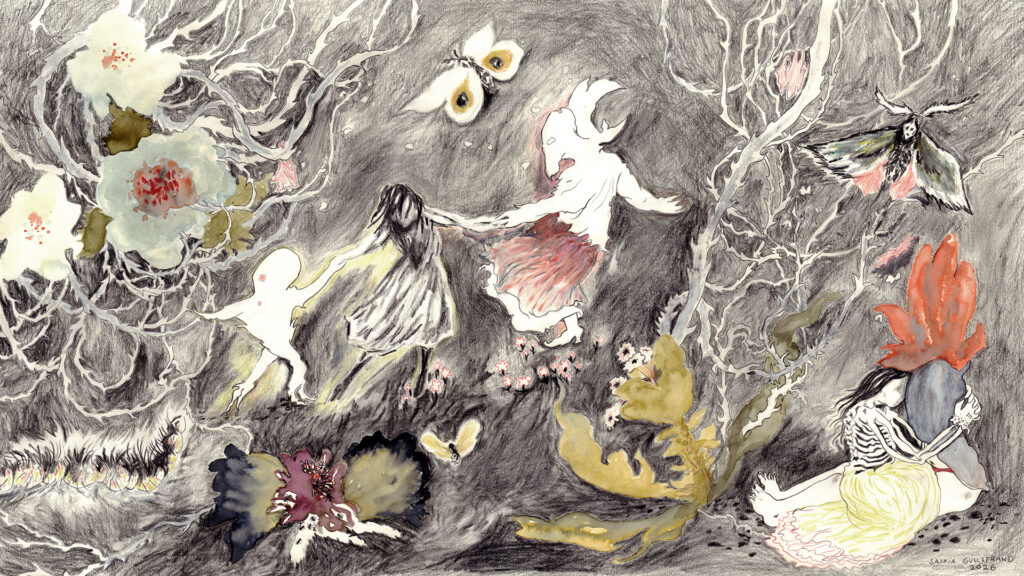
Illustration: Saskia Gullstrand
Admission
Ticket
130 SEK
Are you interested in attending both Friday’s and Saturday’s readings? Please book a ticket for each day.
In collaboration with IASPIS, the Swedish Arts Grants Committee´s International Programme for Visual and Applied Arts.